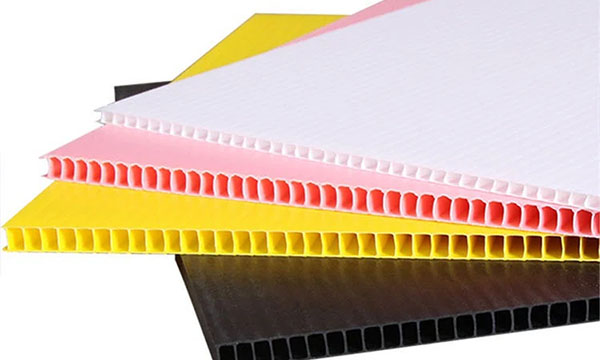
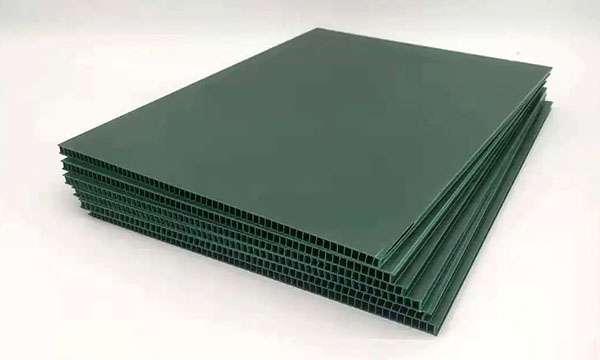
Twinwall polycarbonate sheet is a hollow, fluted panel made from polycarbonate rather than polypropylene — a distinction that matters, because the two materials look similar on a sample rack and behave nothing alike in service. Polycarbonate absorbs impacts that would crack PP, holds its shape at temperatures PP cannot survive, and is normally supplied with a co-extruded UV layer that protects the panel against yellowing and embrittlement in sunlight. It is the material specified for greenhouses, skylights, canopy roofing, carport glazing and architectural screens, where light transmission and insulation both have to hold up for years rather than seasons. We supply it alongside our PP range and quote it project by project.
➤Why Polycarbonate Instead of PP
PP corrugated sheet is the right answer for signage, packaging and short-life protection, and you will find it on our PP corrugated plastic sheet range. It is not the right answer for a roof. Polypropylene softens and creeps under sustained load and summer heat, becomes brittle after prolonged UV exposure, and cracks rather than deforming when struck. Polycarbonate does the opposite: it flexes and absorbs impact, keeps its mechanical strength across the temperature range a roof actually sees, and with a UV layer holds its light transmission instead of hazing over. Where a panel is structural, walk-on, load-bearing or expected to last a decade outdoors, PP should not be substituted on price — the cost of a failure is far higher than the saving on the sheet.
✔Four Mistakes That Crack Polycarbonate Panels
Almost every cracked panel we are asked about was not a material failure. In our experience these four causes account for most of them:
Holes drilled at the panel diameter. Polycarbonate expands and contracts noticeably with temperature. Fastener holes should be oversized to allow movement; a tight hole becomes a crack initiation point.
Clamped rigidly at both ends. One end of a run has to be able to move. Fixing both ends solid is the single most common installation fault.
Flute ends left open. Weather-facing flute ends need anti-dust tape at the bottom and a vented closure at the top, so condensation can drain and escape rather than sit inside the flutes.
UV face installed downwards. The protected side is marked on the film; fit it facing the sun and remove the film only after installation is complete.
Tell us the span, the pitch and the fixing method when you enquire and we will confirm thickness and closure details before the order is placed, not after the first panel fails.
★Greenhouse and Roofing Applications
Greenhouses and polytunnels — insulation and diffused light without the heat loss of single glazing.
Skylights and roof lights — impact resistant where glass overhead would be a safety risk.
Canopies and carports — large spans carried with fewer intermediate fixings.
Architectural screens and partitions — light transmission with privacy from tinted grades.
➤What We Ask Before Quoting
Polycarbonate is specified by application, not by thickness alone, so a quotation starts with five questions: what the panel covers (span and support spacing), the pitch, whether it is walked on or only loaded by wind and snow, the required service life, and the fixing method. With those answers the thickness, UV grade and closure details follow; without them any thickness is a guess.
ℹAbout the Manufacturer
Qingdao Hengsheng Plastic Co., Ltd. has produced PP hollow board since 2012 at Lingang Industry Park, Huangdao District, Qingdao, Shandong, China. Four production lines plus in-house processing equipment give a capacity of 20,000 tons a year, and six departments — production, quality inspection, sales, technical material supply, warehouse and new product development — carry an order from resin to container. Sheet and converted parts are exported to more than 120 countries, including Germany and Japan. See our company profile and our team.
Reviewed by the Hengsheng technical sales team, Qingdao · Last updated: November 2026
Fastener holes sized with thermal expansion allowance
Sample
Available on request
faq
Q: Is this the same material as corrugated plastic sheet?
A: No. Corrugated plastic sheet is polypropylene; this panel is polycarbonate. They share a hollow fluted structure but differ in impact strength, temperature resistance, UV stability and cost.
Q: Can it be used for a greenhouse roof?
A: Yes — this is one of its main uses, because the hollow flutes insulate and the material resists hail impact far better than glass.
Q: Which side faces the sun?
A: The UV-protected side. It is marked on the protective film, which should be removed only after installation is complete.
Q: Why did my panel crack at the fixing?
A: Almost always because the hole was drilled at the fastener diameter or because both ends were clamped rigidly. The panel needs room to expand; see the installation notes above.
Q: Can you supply cut-to-size panels?
A: Yes. Send the panel sizes, span and quantity and we will quote cut panels rather than full sheets.
Q: Do you also supply PP corrugated sheet?
A: Yes. The PP sheet range covers signage, packaging and protection, and clear fluted PP is covered under clear corrugated plastic sheet.
Q: What is the minimum order and lead time?
A: 200 panels for standard sizes, and mixed thicknesses can share one container. Standard panels ship 7 days after the deposit; cut-to-size panels take about 15 days.
Q: What are your payment terms?
A: 30% T/T as deposit, with the balance paid by T/T before shipment. Panel size, structure and UV grade are confirmed in writing before the line is set.
Q: Can you match a sample we send you?
A: Yes. Send a panel or a drawing and we will match thickness, colour, structure and UV grade before quoting, so the quotation reflects the panel you actually need.